
Timing BESS Investments: What Global Market Evolution Tells Us About Japan
Over the past two years, front-of-the-meter battery energy storage systems (BESS) have gradually become an important asset class within renewable energy infrastructure investment.
Compared with solar and wind, however, energy storage is much harder to compare across markets. Power market design, ancillary service products, storage duration, revenue reporting conventions, grid connection costs and financing conditions vary significantly from country to country. Even when revenues are expressed using the same metric, such as US dollars per kilowatt per year, they do not necessarily carry the same economic meaning. Some institutions have begun to provide cross-market benchmarks for BESS revenues, but systematic comparisons remain relatively limited.
Prism Capital currently focuses its research on Japan, Australia, Great Britain, Germany, Poland, as well as ERCOT and CAISO in the United States. Rather than simply asking “which market has the highest revenue today?”, we focus on three questions that are more directly relevant to investment decisions:
When does a power system begin to genuinely need storage?
When can that need be translated into investable commercial revenues?
And once storage capacity begins to grow rapidly, how long can those revenues be sustained?
In other words, the stage of the market determines the revenue opportunity, while the entry price determines the ultimate investment return.
Storage demand begins with a power system’s flexibility gap
As the share of solar and wind generation increases, power systems first face greater variability. Once these forms of variable renewable energy (VRE) reach a certain scale, the need for frequency response, real-time balancing, curtailment management and energy shifting across time becomes more pronounced, increasing demand for flexible resources such as battery storage.
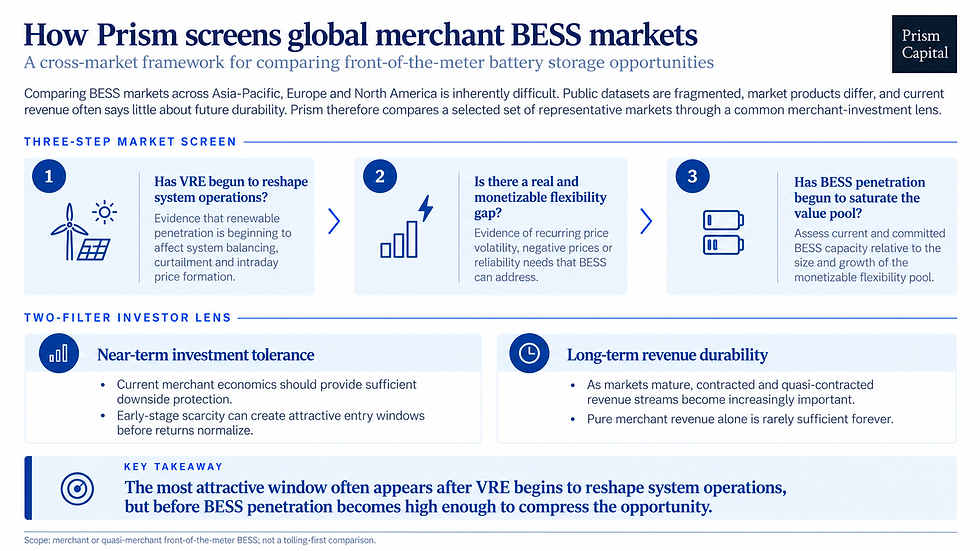
Prism’s Global BESS Market Screening Framework evaluates markets in three steps:
First, have wind and solar begun to have a material impact on power system operations?
Second, has the system developed a genuine and monetisable need for flexibility?
Third, has storage capacity already become sufficiently saturated to materially compress revenues?
For investors, all three conditions matter.
If renewable penetration remains low, storage may be technically viable, but flexibility may not yet be sufficiently scarce to support adequate project revenues. If a flexibility gap has already emerged while storage capacity remains limited, BESS can often capture relatively high marginal value.
Conversely, if storage deployment has already expanded rapidly, project-level revenues may decline materially even if the power system still requires additional storage.
The development of a storage market does not usually follow a simple upward curve.
At an early stage, when VRE penetration is still low, the value of storage remains limited. As renewable generation continues to expand, storage becomes increasingly valuable for frequency response, system balancing and energy shifting, while ancillary service prices and wholesale price spreads also tend to become more pronounced.
High revenues, however, attract additional storage capacity.
As more BESS projects participate in ancillary-service and balancing markets, new supply begins to compete for relatively limited service demand, putting downward pressure on prices. As storage increasingly participates in charging at low prices and discharging at high prices, it can also further compress wholesale electricity price spreads.
From an investment perspective, the more attractive part of the cycle is therefore often the rising phase through the early plateau: system flexibility demand has already formed, but new storage capacity has not yet fully filled the gap.

Renewable penetration is only the starting point; system structure determines the actual value of flexibility
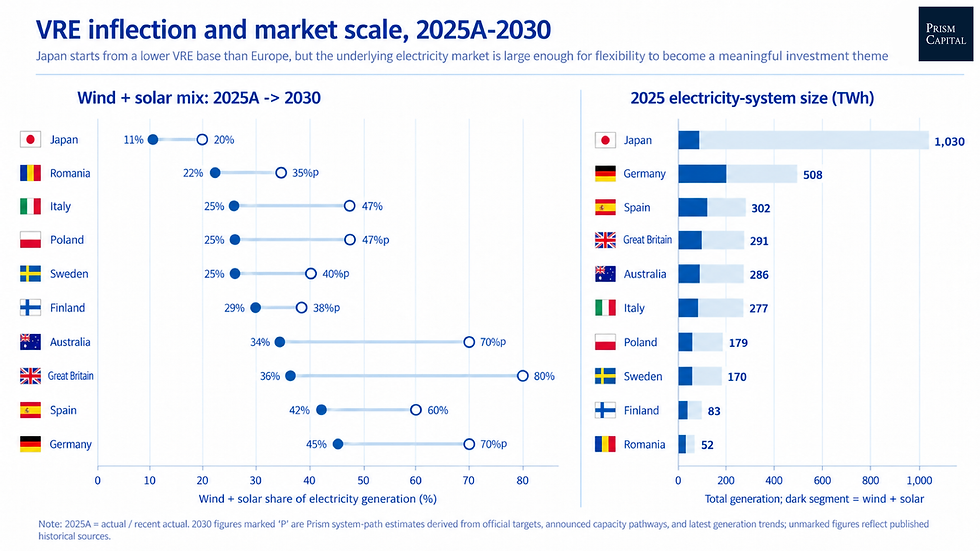
Renewable penetration and demand for storage are generally strongly correlated. Most of the European and Australian markets currently studied by Prism have already reached relatively high levels of wind and solar generation.
From an investment perspective, however, renewable penetration alone does not determine the value of storage.
The size of a power system, its geographic structure, interregional connectivity, and the availability of existing flexibility resources such as thermal generation and pumped hydro all affect the scarcity and marginal value of incremental flexibility.
Japan is a typical example.
Although the overall share of wind and solar generation in Japan remains below that of several mature European markets, its renewable generation base is already substantial and unevenly distributed across regions.
In regions such as Kyushu, solar penetration is already very high during certain periods, and solar curtailment has become increasingly frequent.
More importantly, Japan’s power system is subject to significant regional constraints.
Mainland Japan consists of nine major regional power systems, while eastern and western Japan remain divided by the historical 50Hz and 60Hz frequency split. In addition, transmission capacity between some regions is limited.
This means that when renewable output changes rapidly, the system cannot rely entirely on interregional transmission to absorb those fluctuations. A meaningful portion of supply-demand balancing and frequency response must therefore be resolved within individual regions.
This increases the marginal value of local flexibility resources.
Japan currently has relatively high BESS revenue per unit of capacity, but entry costs are also high
On a per-kilowatt basis, Japan is currently among the higher-revenue BESS markets.
However, construction costs and acquisition prices for operating assets in Japan are also materially higher than in some European and US markets.
Prism estimates that, for a four-hour BESS project in Japan’s high-voltage (HV) grid-connection category, and based on the main market-based revenue streams currently available, gross annual revenue in Japan in 2026 is approximately US$629/kW.
Self-build investment cost, meanwhile, exceeds US$1,400/kW, while acquisition prices for operating assets may be higher still.
As a result, comparing revenue in US dollars per kilowatt per year alone is not sufficient to determine project attractiveness. More important is the margin that revenues provide relative to the cost of entry.

Revenue compression as storage capacity increases is a common pattern across markets
Current high BESS revenues should not be extrapolated linearly into the future.
The growth of storage capacity affects revenues in two ways.
First, additional BESS capacity increases supply in relatively finite markets such as ancillary and balancing services. Second, as more batteries charge during low-price periods and discharge during high-price periods, they also reduce wholesale electricity price spreads.
As a result, new BESS supply not only competes for the existing revenue pool, but can also change the revenue pool itself.
Historical data from ERCOT, CAISO and Australia all show that unit revenues have generally declined as operational BESS capacity has increased. The decline has not been perfectly linear, but the direction has been relatively consistent.
Japan currently combines relatively high unit revenues with relatively low levels of operational BESS capacity. The key question for the Japanese market is therefore how long these high revenues can be sustained.
If new storage supply grows faster than the underlying need for flexibility, investors will need to protect project returns through lower entry costs, more conservative revenue assumptions and a greater use of long-term contractual arrangements.

As markets mature, BESS revenues tend to shift from individual ancillary services toward a more diversified revenue mix
The development of several major markets suggests that BESS revenues tend to become more diversified over time:
Ancillary and balancing services → energy market trading → capacity and long-term contracted revenues
In the short term, relatively high clearing prices for ancillary and balancing services can help investors recover project costs more quickly.
Over the longer term, however, maintaining relatively stable revenues generally requires multiple revenue sources.
Germany and Poland currently remain relatively dependent on ancillary and balancing service revenues. Great Britain has developed a multi-layered revenue structure combining energy arbitrage, ancillary and balancing services, and capacity value, while Australia has become more dependent on energy arbitrage.
Under Prism’s base-case assumptions, BESS revenues in Japan over the next several years are still expected to depend significantly on the balancing market, while gradually shifting toward a greater contribution from energy trading and capacity-related revenues.
Prism therefore sees the current Japanese investment thesis as consisting of two stages:
Stage One: while supply and demand in ancillary and balancing services remain relatively tight, projects can use higher market-based revenues to improve early cash recovery;
Stage Two: as ancillary and balancing service revenues gradually compress, the contribution from energy trading, the capacity market and long-term contractual revenues will need to increase.

Where does Japan currently sit in the global BESS market?
Prism compares several major BESS markets across two dimensions: operational BESS penetration—defined here as operating grid-scale BESS capacity relative to peak system demand—on the horizontal axis, and current market-based BESS revenue intensity on the vertical axis.
The positioning is intended as an indicative market-screening framework rather than a precise quantitative ranking.
Low revenue / Low penetration
These markets are generally still at an earlier stage. The power system may not yet have developed a sufficiently clear need for flexibility, and investors may need to wait for both market mechanisms and system demand to develop further.
High revenue / High penetration
The need for system flexibility is already well established, but storage deployment is also relatively high. Investors therefore need to focus on the pace of new supply and revenue compression.
Low revenue / High penetration
These are generally more mature markets. Project returns depend more heavily on energy trading, long-term contracts, a lower cost of capital and stronger operating capabilities.
High revenue / Low penetration
This is the area Prism focuses on most closely. These markets have developed a genuine need for system flexibility, but storage supply has not yet fully caught up. Based on our current comparison, Japan and some European markets are closer to this quadrant.
Being in this quadrant does not mean that projects will naturally generate high returns.
Investors must also assess market size, entry costs, the depth of the revenue pool and the future pipeline of new projects.
Overall, Japan currently has four characteristics that we believe are worth highlighting.
First, the power system is large. Even if flexibility demand represents only a portion of the overall system, the absolute market size remains meaningful.
Second, renewable energy remains in a growth phase. Continued additions of wind and solar capacity should increase demand for frequency response, energy shifting and regional renewable integration.
Third, commercial mechanisms for storage have already been established. The balancing market, wholesale electricity market and capacity market provide BESS with multiple potential revenue sources.
Fourth, current BESS penetration remains relatively low. Compared with several more mature markets, supply has not yet fully filled the emerging flexibility gap.
At the same time, Japan is not a low-risk market.
High construction and acquisition costs, together with potential revenue compression as additional BESS capacity comes online, are currently the two most important countervailing factors in the investment case.

Conclusion
One of the key differences between front-of-the-meter battery storage and more traditional renewable energy assets is that project revenues change as the market itself develops.
For BESS investors, the timing of market entry can therefore be just as important as the project itself.
Prism focuses on markets where the need for system flexibility is already evident and commercial monetisation mechanisms are in place, but new storage supply has not yet fully compressed project returns.
From this perspective, Japan remains one of Prism’s key markets for investment and ongoing research.
Whether project returns can be sustained will ultimately depend on three variables:
Entry cost, the pace of revenue compression, and the ability of assets to transition from balancing-market revenues toward energy trading, capacity value and long-term contracted revenues.